
Solar for Schools
Pop Quiz – Do You Know Why Schools Go Solar with Illinois Shines?
Many public schools across Illinois have gone solar to save on costs, improve facilities, have a positive environmental impact, and create educational opportunities for students and the community.
Solar can help schools:
- Reduce and manage rising electricity costs
- Stabilize operations budgets and support long-term planning and infrastructure goals through reduced facility expenses, and upgraded, healthier facilities
- Support science, technology, engineering and math (STEM) curriculum and student career exploration
More schools are going solar through Illinois Shines! Participation in Illinois Shines allows public schools to benefit from valuable economic incentives, work with Approved Vendors vetted and monitored by the Program, rely on valuable consumer protections, access support from the program team, and more. Every school and district is different, but Illinois Shines can help your team explore solar, build a team, evaluate possibilities, and advance a project that’s right for you! Read on to see how schools are getting started and succeeding with Illinois Shines.
Your Path to Solar in Seven Steps!
Like any school improvement project, installing solar needs a good plan! Illinois Shines has built a project planning guide that outlines the necessary steps a School can take to go solar. Find below the Illinois Shines roadmap to solar success and make sure to download the Public Schools Solar Project Guide to keep these steps and other helpful tips handy.

Our Public Schools Solar Project Guide and our team support your journey, including:
1. Create a Team to Guide the Project
Start by building a small, internal team of administration, facilities, and educational staff to lead the project. This team will review how solar projects can be developed under Illinois Shines, available incentives, the best system design for your school, and the total cost. Illinois Shines has a dedicated Public Schools Strategist that can share program details and resources,set up a tailored workshop for your school, and share success stories from other schools.
A successful project typically begins by bringing together district leadership, facilities professionals, educators, and outside partners.
- School District Administrators:
Set the district-wide vision, approve budgets and capital plans, and help guide the overall project direction to make sure solar is a responsible and cost-effective investment. They review long-term cost and savings projections, analyze finance and contract terms, oversee purchasing and proposals, help guide communication with the school board, champion the project publicly, and ensure Program compliance. - Facilities and Operations Teams:
Essential partners who can help evaluate the physical conditions of the site—including whether the system should be mounted on the ground or roof—its electrical system’s capacity, and determine whether onsite (distributed generation) or community solar make the most sense. They also coordinate site visits and installation logistics with the solar developer, to minimize disruption to students, and support safe construction practices. - Educators and Solar Champions:STEM teachers, sustainability–minded faculty, and parents, including Parent Teacher Organizations, who can help champion solar projects! From advocating for sustainability at PTO and community meetings, to incorporating solar into student lessons plans, these team members play a key role in generating community support and enthusiasm.
2. Conduct an Energy Audit and Roof/Grounds Assessment
You can assess project possibilities for your school by examining your buildings and grounds, your current and projected energy use, and other facilities improvement possibilities. Your facilities and operations staff are critical contributors here.
Many schools begin with a Public Schools Carbon-Free Assessment, a smart first step in your solar journey to see where solar fits into your school’s capital and energy strategy. Public School Carbon-Free Assessments are free energy evaluations offered by ComEd and Ameren to all Illinois public schools in the ComEd or Ameren service territory. These assessments help schools understand how their buildings currently utilize energy and identify opportunities to improve energy efficiency, reduce energy use, and implement upgrades, like solar power, that will have the most impact towards becoming carbon-free.
3. Choose a Participation Avenue and Project Type
Your school can construct either a distributed generation (DG) or a community solar (CS) project to participate in the program. Learn more about each project type below.
- A distributed generation (DG) system is located on-site and generates electricity that serves only the school it is constructed on. The installation can be accomplished through a developer or by the school itself, and can be financed through direct purchase, a lease, or a Power Purchase Agreement (PPA). On site projects can be located on a rooftop, a parking lot canopy system, or on the ground.
- A school can install a community solar (CS) project with the help of a solar developer. Community solar projects are large systems that serve a school’s electrical needs and multiple utility customers through subscriptions. This approach allows the entire community to take advantage of the project. In the Illinois Shines Public School category, Community Solar projects will have to abide by the following requirements:
- The school must act as an “anchor tenant” for the life of the project, subscribing to at minimum 10% and no more than 40% of the project’s energy generation
- The project must retain at least 50% of capacity for small subscribers (subscriptions of less than 25 kW)
4. Find or Become an Illinois Shines Approved Vendor
Approved Vendors are entities approved by Illinois Shines to submit project applications, which result in contracts to which they are counterparties. AVs have important program responsibilities and requirements, and interested entities must complete and submit an Approved Vendor application form, which will be reviewed and approved by the Program Administrator. The approval process must be completed before any project applications can be submitted by an Approved Vendor to the Program. Some schools become Approved Vendors (even to submit a single project application) while others work with existing Approved Vendors. You can learn more about becoming an AV here, or find a list of AVs here. The Illinois Shines website also provides resources such as the Introduction to Illinois Shines: Solar Basics & More guide, and other materials, including helpful tips, questions to ask and more.
5. Explore Financing Options and Funding Opportunities
Illinois Shines provides valuable incentives that can reduce the total price of constructing a solar project! The Illinois Shines team can answer questions about financing types, including Purchase, Lease, or Power Purchase Agreements for distributed generation, or how community solar can boost community engagement. The Illinois Shines team can also share information about other funding sources available to public schools and tax benefits offered outside the program, such as the federal clean energy tax credit accessible through Elective Pay through 2027. Your district should determine the approach that best fits your budget and financing needs and long-term goals.
Jump down to the Solar Toolkit for information about your financing options →
6. Engage Community Stakeholders
School boards, parents, staff, and students often have questions, and speaking with them is a chance to build excitement for solar! Solar project teams should share project goals, potential savings, financial projections, educational and health benefits, and timelines with community stakeholders. Illinois Shines can provide program information for presentations, FAQs, examples and success stories from other schools, and more as you build support across your community.
After gathering stakeholder input, some schools build a request for proposals (RFP) to solicit bids for their desired criteria from interested solar developers, including Illinois Shines Approved Vendors.
Jump down to the Solar Toolkit for tips to evaluate an Approved Vendor →
7. Get Ready To Submit Your Project Application
To participate in Illinois Shines and benefit from incentives and other support, public schools must submit a project application for program approval. Once you’ve selected a path forward, whether on your own or with an Illinois Shines Approved Vendor, Illinois Shines can support your project team as you finalize design details, confirm financial terms, and prepare the necessary documentation for your project application. If you’re working with an Illinois Shines Approved Vendor, they’ll submit the project application and keep you informed as the project moves from review to approval to construction.
Step 1. Create a Team to Guide the Project
Start by building a small, internal team of administration, facilities, and educational staff to lead the project. This team will review how solar projects can be developed under Illinois Shines, available incentives, the best system design for your school, and the total cost. Illinois Shines has a dedicated Public Schools Strategist that can share program details and resources, set up a tailored workshop for your school, and share success stories from other schools.
A successful project typically begins by bringing together district leadership, facilities professionals, educators, and outside partners. Click the plus sign below to learn more about these groups.
School District Administrators set the district-wide vision, approve budgets and capital plans, and help guide the overall project direction to make sure solar is a responsible and cost-effective investment. They review long-term cost and savings projections, analyze finance and contract terms, oversee purchasing and proposals, help guide communication with the school board, champion the project publicly, and ensure Program compliance.
Facilities and operations teams are essential partners who can help evaluate the physical conditions of the site—including whether the system should be mounted on the ground or roof—its electrical system’s capacity, and determine whether onsite (distributed generation) or community solar make the most sense. They also coordinate site visits and installation logistics with the solar developer, to minimize disruption to students, and support safe construction practices.
Educators and solar champions are STEM teachers, sustainability–minded faculty, and parents, including Parent Teacher Organizations, who can help champion solar projects! From advocating for sustainability at PTO and community meetings, to incorporating solar into student lessons plans, these team members play a key role in generating community support and enthusiasm

Step 2. Conduct an Energy Audit and Roof/Grounds Assessment
You can assess project possibilities for your school by examining your buildings and grounds, your current and projected energy use, and other facilities improvement possibilities. Your facilities and operations staff are critical contributors here.
Many schools begin with a Public Schools Carbon-Free Assessment, a smart first step in your solar journey to see where solar fits into your school’s capital and energy strategy. Public School Carbon-Free Assessments are free energy evaluations offered by ComEd and Ameren to all Illinois public schools in these utilities’ respective service territories. These assessments help schools understand how their buildings currently utilize energy and identify opportunities to improve energy efficiency, reduce energy use, and implement upgrades, like solar power, that will have the most impact towards becoming carbon-free.

Step 3. Choose a Project Type
Your school can construct either a distributed generation (DG) or a community solar (CS) project to participate in the program. Learn more about each project type by clicking the plus sign below.
Distributed Generation
A distributed generation (DG) system is located on-site and generates electricity that serves only the school it is constructed on. The installation can be accomplished through a developer or by the school itself, and can be financed through direct purchase, a lease, or a Power Purchase Agreement (PPA). On site projects can be located on a rooftop, a parking lot canopy system, or on the ground.
Community Solar
A school can install a community solar (CS) project with the help of a solar developer. Community solar projects are large systems that serve a school’s electrical needs and multiple utility customers through subscriptions. This approach allows the entire community to take advantage of the project. In the Illinois Shines Public School category, Community Solar projects will have to abide by the following requirements:
- The school must act as an “anchor tenant” for the life of the project, subscribing to at minimum 10% and no more than 40% of the project’s energy generation
- The project must retain at least 50% of capacity for small subscribers (subscriptions of less than 25 kW)

Step 4. Find or Become an Illinois Shines Approved Vendor
Approved Vendors are entities approved by Illinois Shines to submit project applications, which result in contracts to which they are counterparties. AVs have important program responsibilities and requirements, and interested entities must complete and submit an Approved Vendor application form, which will be reviewed and approved by the Program Administrator. The approval process must be completed before any project applications can be submitted by an Approved Vendor to the Program. Some schools become Approved Vendors (even to submit a single project application) while others work with existing Approved Vendors. You can learn more about becoming an AV here, or find a list of AVs here. The Illinois Shines website also provides resources such as the Introduction to Illinois Shines: Solar Basics & More guide, and other materials, including helpful tips, questions to ask and more.

Step 5. Explore Financing Options and Funding Opportunities
Illinois Shines provides valuable incentives that can reduce the total price of constructing a solar project. The Illinois Shines team can answer questions about financing types, including Purchase, Lease, or Power Purchase Agreements for distributed generation, or how community solar can boost community engagement. The Illinois Shines team can also share information about other funding sources available to public schools and tax benefits offered outside the program, such as the federal clean energy tax credit accessible through Elective Pay for projects completed by the end of 2027. Your district should determine the approach that best fits your budget and financing needs and long-term goals.
Jump down to the Solar Toolkit for information about your financing option →

Step 6. Engage Community Stakeholders
An important component of any school solar project is educating students, parents, and the larger community about the project’s details and benefits. Your school can build solar education into student curricula to demonstrate the project’s energy generation or highlight the energy and cost savings to board members and parents. Illinois Shines can provide program information for presentations, FAQs, examples and success stories from other schools, and more as you build support across your community.
After gathering stakeholder input, some schools build a request for proposals (RFP) to solicit bids for their desired criteria from interested solar developers, including Illinois Shines AVs. Utilize our solar toolkit for tips to evaluate an AV.
Jump down to the Solar Toolkit for tips to evaluate an Approved Vendor →

Step 7. Get Ready To Submit Your Project Application
Once you have identified an AV, a solar project type, and a financing type, the Approved Vendor will submit an application to the Illinois Shines program on the school’s behalf. Alternatively, the school may choose to register as an Approved Vendor with the Program and submit the project itself.
Illinois Shines has a dedicated Public Schools Strategist who can share program details and resources, set up a tailored workshop for your school, and share success stories from other schools.

Request a Tailored Workshop
The Illinois Shines team offers personalized, one-on-one workshops for public schools and districts.
These sessions can include:
- Review of your school’s Carbon-Free Assessment results
- Discussion of project possibilities for your buildings
- Answers to questions about project planning, financing, Illinois Shines incentives and other funding sources
- Guidance for forming project teams, engaging your community, or finding Illinois Shines approved vendors, and more
Your Solar Toolkit
Illinois Shines provides resources designed for public schools to discuss, plan, and implement solar projects. Check out these resources, and watch a recorded presentation (or read the presentation slides) covering the details of the Public Schools category. You can also begin by requesting a tailored workshop for your school or to talk to an Illinois Shines Public Schools Strategist.
Explore and Compare Financing Options (DG) and Subscription Information (CS)
|
|
System Purchase (including with loan) (Distributed Generation)
|
Leases (Distributed Generation)
|
PPAs (Distributed Generation)
|
Community Solar
|
|---|---|---|---|---|
|
Overview
|
Through direct ownership, the school purchases and owns the system. This leads to a higher upfront cost, but the district benefits from the full value of energy savings over the system’s life.
|
With a lease, your schools pays a fixed amount to use the solar system over a set period, which allows for predictable budgeting.
|
With a PPA, a third party owns, operates, and maintains the solar system on your property. Your school only pays for the electricity your system uses, usually at a rate lower than your current utility, gaining the benefits of solar with little or no upfront capital cost.
|
With a CS project, schools buy power from an offsite project which supplies multiple entities.
|
|
Operation and Maintenance
|
Owner maintains control over upgrades and maintenance.
|
Lease provider handles system maintenance.
|
PPA provider handles system maintenance.
|
N/A
|
|
Risk and Liability
|
Owner maintains risk and liability responsibilities and is responsible for securing insurance.
|
Lease provider handles risk.
|
PPA provider handles risk.
|
N/A
|
|
Who owns the system if the property with the system is sold?
|
Owner is responsible for sale and outstanding loans.
|
Contract-dependent. Some leases may offer a path to ownership at the end of the term.
|
Contract-dependent. Contract terms define pricing, escalators, and the end of term options
|
Contract-dependent
|
|
Contract lengths
|
15- or 20-year
|
15- or 20-year
|
15- or 20-year
|
20-year
|
Tips for Evaluating an Approved Vendor
Whether your school is pursuing a DG or CS project, a strong partner should demonstrate technical expertise, transparent pricing, and a clear understanding of Illinois Shines requirements. Energy consultants for schools can help you prepare for and issue a Request for Proposal to find the best solar partner.
Green Flags
- Registered with Illinois Shines as an AV or Designee and has completed projects for public school clients.
- Provides complete proposals with itemized pricing and cost assumptions and explains how incentives are implemented.
- Proposes contracts aligned with school-district timelines, identifies responsibilities during outages, performance guarantees, and end-of-term options.
- Presents the project effectively to school administration, facilities teams, and community stakeholders.
- You are allowed time to review and fully understand the offer, and the company can provide references from public sector clients.
Red Flags
- The solar company misrepresents or suggests affiliation with a utility, the state, or a government agency or program or has a history of Program complaints, violations, or disciplinary action.
- Provides vague or incomplete proposals for pricing, production estimates, or contract terms.
- Offers unrealistic savings projections without supporting documentation.
- Are unwilling to answer detailed technical or financial questions during the RFP process.
- Pressures your district to sign before due-diligence is conducted by your schools administrative, legal, and engineering teams.
Additional Funding Resources
The Illinois Shines team can also share information about other funding sources available to public schools and tax benefits offered outside the program including:
- A Federal clean energy tax credit is accessible through Elective Pay for projects completed by the end of 2027.
- The Illinois Climate Bank offers bridge loans to provide short-term financing to cover the period between funding a renewable energy or energy efficiency project and receiving federal tax credits (including elective pay), renewable energy credits (RECs), or other financial incentives.
To learn more about the latest information on available funding resources, connect with the Public Schools Sector Strategist at [email protected].
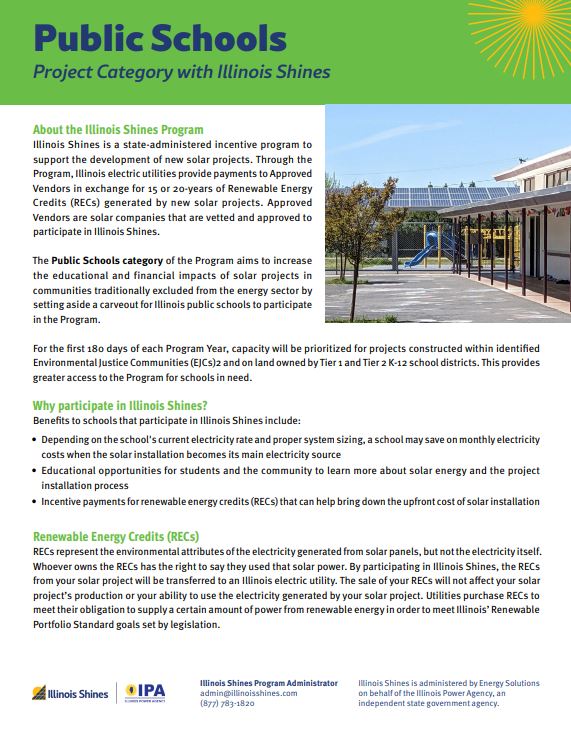
Public Schools Program Category Brochure
Learn more about the Public Schools category in Illinois Shines.
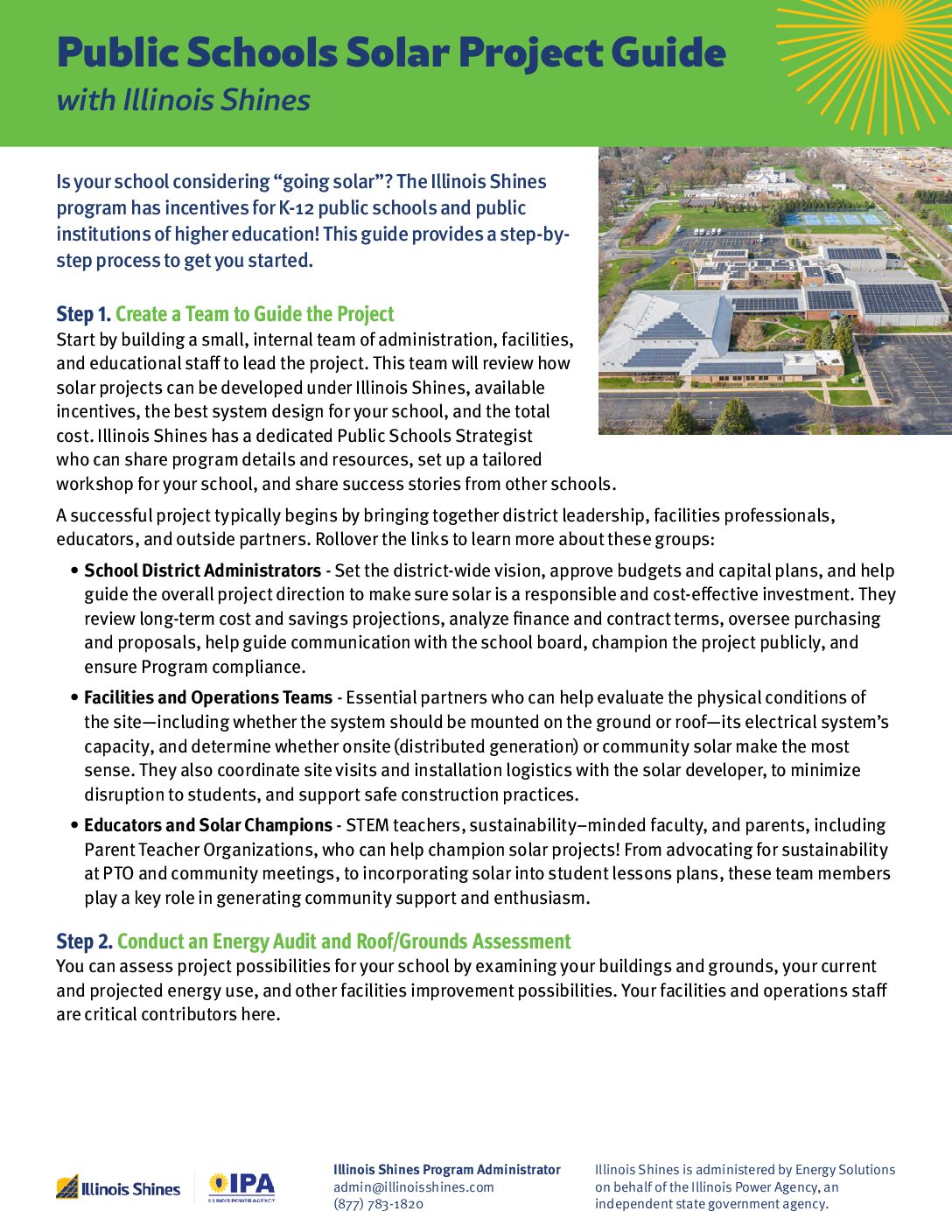
Public Schools Project Guide
Check out the next steps for schools looking to go solar.

Palestine Elementary School
School District #3
Manteno Elementary School,
Manteno Middle School, and
McClean County Unit 5 Bus Barn
School District #5
Prairie Ridge High School
School District #155
Cassens Elementary School
School District #7
Goshen Elementary School
School District #7
Edwardsville High School South and Jon Davis Wrestling Center
School District #7
Dunlap High School
School District #322
Winnebago High School,
Winnebago Middle School, and
Jean McNair Elementary School
School District #323
Odin Schools
School District #722
Chrisman Elementary School
and Chrisman High School
School District #6
Dorothy Simon Elementary
School District #323
Harrisburg Middle School and Bulldog Early Learning Academy
School District #3
Evansville Attendance Center
School District #140
Jordan Elementary School and
Schiller Elementary School
School District #135
Northpoint Elementary School
and Unit 5 Warehouse Offices
School District #5
Odell School District
School District #435
Join The Club of Solar Schools in Illinois Shines!
Nearly 100 Illinois schools have already installed solar through Illinois Shines, and nearly 30 have submitted through the Public Schools category since it became available! And a growing list of other schools are actively planning projects in the program. Explore the interactive map to see which schools are already benefiting from solar energy through Illinois Shines’s Public Schools category.
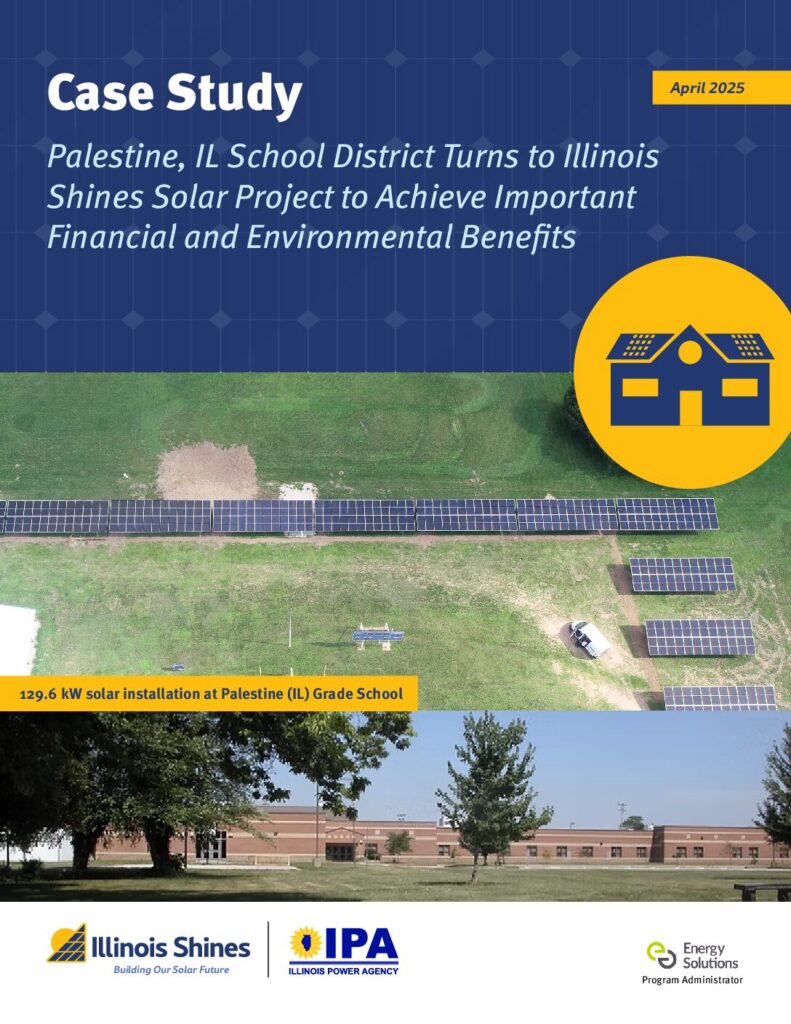
Public Schools Case Study
Palestine School District
Read how the Palestine School District #3 leveraged the Illinois Shines program to bring their solar ambitions to life and benefit their community in this Public Schools Case Study.
Frequently Asked Questions
Going solar is a big step! Have questions? We’ve gathered the answers to the most common questions from school administrators, facilities team, and board members to help you understand how Illinois Shines works!
What is the Program’s definition of a public school?
Under the Illinois Power Agency Act, the definition of “public schools” for this Program comes from the Illinois School Code, which includes any public school, common school, alternative public school, or free school operated by the authority of the Illinois School Code, including Illinois public schools from pre-school through grade 12, and vocational schools over which the State Board of Education has authority, and includes public institutions of higher education, as defined in the Board of Higher Education Act per the enactment of P.A. 103-0580.
(Updated July 2026)
What types of REC Contracts are available in the public schools category?
As of June 1, 2026, Public School Distributed Generation projects will be placed on a 15-Year REC Contract.
- Projects up to and including 25 kW in size will receive 50% upfront payment at Energization and the rest paid out quarterly over 6 years.
- Projects over 25 kW in size will receive 15% upfront payment at Energization and the rest paid out quarterly over 6 years.
Public School Community Solar projects will continue to be placed on a 20-Year REC Contract for which REC payments are paid out quarterly based on actual REC deliveries.
(Updated July 2026)
Will solar power fully replace the school’s electricity from the utility?
No. The school will remain connected to the electric grid. Solar panels can reduce the amount of electricity purchased from the utility, but the grid continues to supply power when solar production is low such as at night or during cloudy conditions. Additionally, solar can provide protection against rising energy prices by locking in predictable, and often lower, costs for electricity.
(Updated July 2026)
Can panels cause glare or other disruptions near classrooms?
Solar panels are designed to absorb light, not reflect it. As such, glare is uncommon and panels are generally less reflective than windows or other building materials. Additionally, schools can work with their AV on panel placement and orientation to minimize any potential impacts.
(Updated July 2026)

Does the solar system benefit the local community?
Solar reduces demand on the local grid, can lower emissions by displacing generation from fossil fuels, and demonstrates fiscal responsibility and environmental leadership within the community. With Community Solar Public Schools projects, the community has the potential to benefit from a subscription to the project.
(Updated July 2026)
What can students learn when a solar array is built on their school?
Some systems have built in trackers that allow teachers to use real-time data from school solar systems to teach students about solar energy and environmental stewardship. Students can analyze power output, track weather impacts, and explore the math and science behind solar generation. Some schools integrate solar monitoring dashboards into their STEM curriculum, allowing students to track daily and annual solar performance. These activities inspire interest in sustainability and prepare students for careers in engineering, renewable energy, and environmental science — cultivating the next generation of clean-energy leaders.
(Updated July 2026)
What resources are available to help navigate the process?
The Illinois Shines Public Schools Sector Strategist offers personalized, one on one workshops and can be contacted at [email protected]. The Program also vets and monitors AVs who manage much of the technical and administrative work associated with a solar project, helping reduce the burden on school staff.
(Updated July 2026)
What’s the first step to bringing solar to my school?
Most schools begin by engaging with district leadership and facilities staff to ensure alignment. Schools should then review their available roof space, parking areas, and available open land, while considering their energy use and long-term goals. From there, schools can connect with the Illinois Shines Program Administrator at [email protected] or an AV who can help evaluate site feasibility, estimate costs and savings, and explain incentive options.
(Updated July 2026)
Get Started Today!
Connect with an Illinois Shines Public Schools Strategist today! You can begin accessing personalized support and discussion on your district’s goals, auditing your energy profile and facilities, project planning, financing, and next steps to move your project forward.
Contact a Public Schools Strategist
Start a conversation about solar at your school and get personalized support from Illinois Shines!
Request a Tailored Workshop
In addition to our webinar, you can request a tailored workshop with Illinois Shines and other public schools solar experts.